
Training for Impact: Strengthening Laboratory Capacity for Wastewater Surveillance
From its inception, the WaSPP consortium has recognised the importance of answering a critical question:
How can we reliably recover and detect pathogens with pandemic potential in wastewater?
To address this, we spent several months comparing eight different methods of concentrating viruses—a key step that increases the chances of detecting viral signals from wastewater.
After a significant effort by the team, it was determined that electronegative filtration (ENF) and magnetic bead–based concentration using Ceres Nanotrap A particles were the two best concentration methods for side-by-side comparison at labs implementing wastewater surveillance.

From protocols to practice
Developing a robust protocol was only the first step. The real challenge was ensuring it could function effectively in laboratories across different countries, each with its own resources, infrastructure, and wastewater conditions. Achieving this required close collaboration among scientific teams - sharing experiences, comparing results, and jointly refining approaches to suit their local contexts.
Since March 2026, we have focused on the transition from protocol to practice, carrying out training on the wastewater concentration method across the consortium. Our goal was to provide training and understand challenges in the implementation of the protocol across the consortium, allowing us to address any concerns, adapt as required and strengthen capacity to generate actionable wastewater data.
First field test of the WaSPP workflow
Institut Pasteur du Cambodge hosted the first WaSPP consortium workshop on concentration‑to‑sequencing workflow in Phnom Penh, with consortium members from Universiti Malaya, Universiti Malaysia Sarawak and Universitas Gadjah Mada, as well as collaborators from Temasek Life Sciences Laboratory and Duke‑NUS Medical School.
Having multiple institutions at the workshop in Cambodia gave participants the chance to troubleshoot in real time, compare experiences across countries in the Southeast Asian region, and better understand how the WaSPP methods could fit into day-to-day laboratory work.

The workshop also provided the first opportunity for WaSPP consortium members beyond the core method development group to run the full laboratory workflow and observe its performance on wastewater samples in Cambodia. Working side-by-side, participants applied the two selected concentration methods and followed the entire protocol from sample concentration to sequencing.
As Dr. Mariela Saba Villarroel, Postdoctoral Researcher at Institut Pasteur du Cambodge, explained, the workshop allowed her “connect each step and understand how they contribute to the overall surveillance system in an integrated way."
Integrating into existing processes
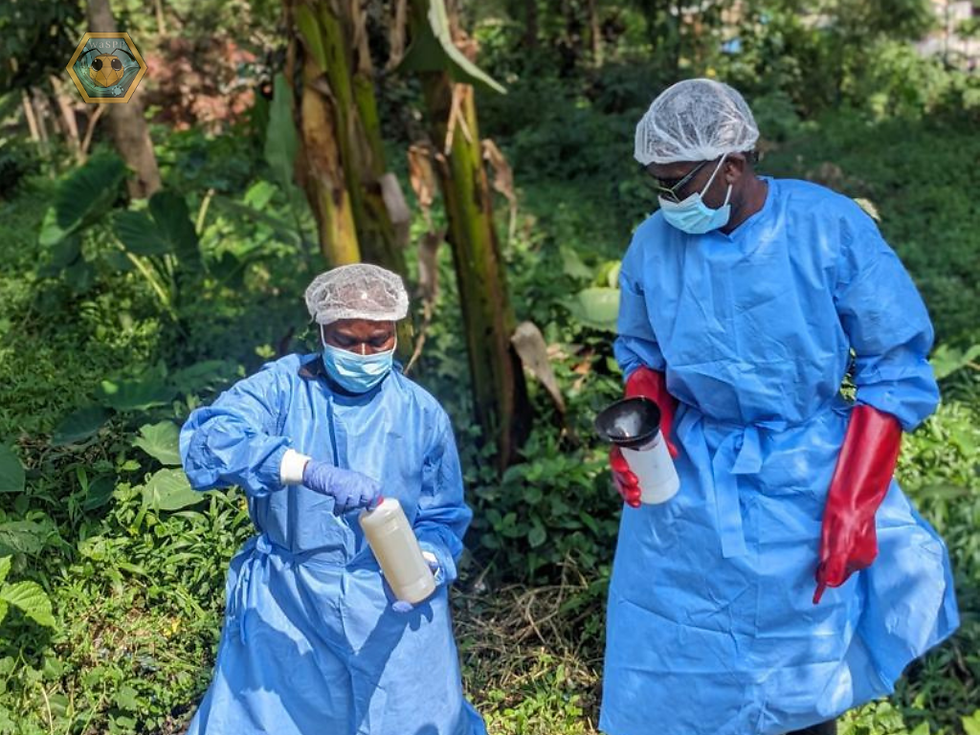
Across the world, in the Democratic Republic of the Congo, team members from Institut National de Recherche Biomedicale (INRB) worked with Kirsten Williamson from Biosurv International to learn the protocol, with a particular focus on implementation into existing laboratory work. After comparing both methods, Julie Tuenakoko, a medical biologist at INRB, commented on her preference for the ENF method, saying that it was “simpler and faster than the Ceres method ... it allows you to effectively process several samples in a reduced time and to quickly move on to extraction."

The last of the training workshops took place at the Genomic and Infectious Disease Laboratory (GIDL), Kwame Nkrumah University of Science & Technology (KNUST) in Ghana. Over five days, team members gained practical experience with both the ENF and Ceres concentration methods, performed bioinformatic analysis using bespoke software and successfully completed the full wastewater surveillance workflow.

Learning and improving together
Rather than focusing on results, the workshops centred on observing how method workflows performed in practice across different laboratories. This created space for meaningful two‑way knowledge exchange - between trainers and participants and among participants themselves.
For Endah Supriyati, a PhD student at Universitas Gadjah Mada, the chance to work alongside peers using the same framework was particularly meaningful:
“The opportunity to connect with so many people working within the same framework… People openly shared real‑world challenges, troubleshooting tips, and lessons learned. This stood out to me."
For Kirsten Williamson, her experience of training reinforced the value of bringing diverse laboratory perspectives together:
“It’s always important to run the workflow across different laboratory settings because everyone has a different way of doing things. It’s a great opportunity to share these and learn new tips and tricks from each other. It’s also a valuable moment to identify any potential challenges the lab teams may face in real time and troubleshoot them together”.

For Dr Michael Owusu at Kwame Nkrumah University of Science and Technology, the training represented a significant step forward in GIDL’s ability to conduct independent wastewater-based epidemiological surveillance for emerging and re-emerging viral pathogens in Ghana.
‘The expert trainers from the WaSPP consortium ensured high-quality, standardised knowledge transfer, and the hands-on laboratory format was particularly effective in building participants' confidence and practical competence’ - Dr Michael Owusu.
Beyond the training
By bringing teams into shared laboratory spaces, the consortium created opportunities for real‑time troubleshooting, cross‑country comparison, and collective refinement of methods. These experiences not only improved the performance and usability of the workflow but also empowered laboratories to integrate wastewater surveillance into their existing systems with confidence.
The WaSPP training workshops demonstrated that strengthening wastewater surveillance capacity goes far beyond transferring protocols - it relies on building a collaborative community of scientists who learn, adapt, and problem‑solve together.


Comments