
Finding the Right Flow: Identifying Optimal Sites for Wastewater Surveillance
- tiqbal28
- Jun 5
- 3 min read
Updated: Jun 8
By Dr Vicka Oktaria and Rizka Dinari
Wastewater surveillance (WES) is emerging as one of the most promising tools for detecting disease transmission at the community level and strengthening public health preparedness. To unlock its full potential, thoughtful decisions must be taken about where and how to sample, all of which must be grounded in epidemiological evidence, population data, and local realities.
As part of the global Wastewater Surveillance for Pandemic Prevention (WaSPP) project, Universitas Gadjah Mada (UGM) has completed the selection of surveillance sites in Indonesia. This milestone was achieved through three key activities: mapping historical infections in humans and animals, conducting GIS-based catchment generation and population estimation analyses to ensure each site captures a meaningful signal, and leveraging existing polio surveillance infrastructure to maximise efficiency. As a result, the UGM team selected 22 sites across six provinces in Indonesia for fortnightly sampling.

Twenty-two sites were selected across six provinces in Indonesia for surveillance.
Reflections From the Field: What Surprised, Challenged, and Inspired Us
While mapping the risk of historical infections across various geographies, one of the most striking aspects was the sheer diversity of data sources required to build a complete picture. Peer-reviewed studies, government dashboards, and disease-specific reporting systems each offered valuable insights and also revealed gaps. Some overlap in information occurred, as several datasets reported aggregated case numbers over defined time periods, while others suffered from underreporting, especially for diseases that are not routinely diagnosed in clinical settings.
The Ministry of Health provided strong prevalence data for Mpox, SARS‑CoV‑2, and dengue, which remains endemic across Indonesia. However, for other priority pathogens, including Nipah, Zika, Hantavirus, Chikungunya and Avian Influenza (H5N1 and H5N6), routine surveillance is far less consistent. To comprehensively understand the geographic distribution and potential risk for these pathogens, the team relied on scientific literature and historical reports.
By leveraging the long‑standing polio environmental surveillance network, the Indonesia team was able to focus on refining methods and coverage rather than designing a new system from scratch. Existing sites also bring an established sampling infrastructure with existing laboratory and sample collection pathways, which is critical in a diverse geography spanning four islands. Leveraging existing networks also supports long‑term project sustainability, creating a pathway for wastewater surveillance to transition from a pilot project into a routine part of Indonesia’s public health system.

Whilst completing site selection, a major technical challenge emerged: how to estimate the catchments and associated populations leading to each site. With limited formal sewer networks and widespread informal wastewater flows, delineating service areas is far from straightforward. To overcome this, the team used a GIS-based approach with ArcGIS and es.world software to generate catchments from elevation and sewer network data and thus predict catchment populations more accurately. This is an essential step toward building a reliable and actionable wastewater surveillance system.
“Using a GIS-based platform like es.world really makes it easier to estimate population coverage from wastewater flow accumulation. It’s very useful for early screening and for identifying potential sampling locations.” – Rahman, UGM, Indonesia team (field assistant, es.world user).
Validating Sites to Ensure Reliable and Actionable Signals
Once potential sites were identified, it was necessary to validate whether each location could support high‑quality surveillance by reviewing physical, operational, and institutional conditions on the ground. Site visits and consultations with local operators helped assess key factors such as accessibility, flow consistency, and safety of sampling points.

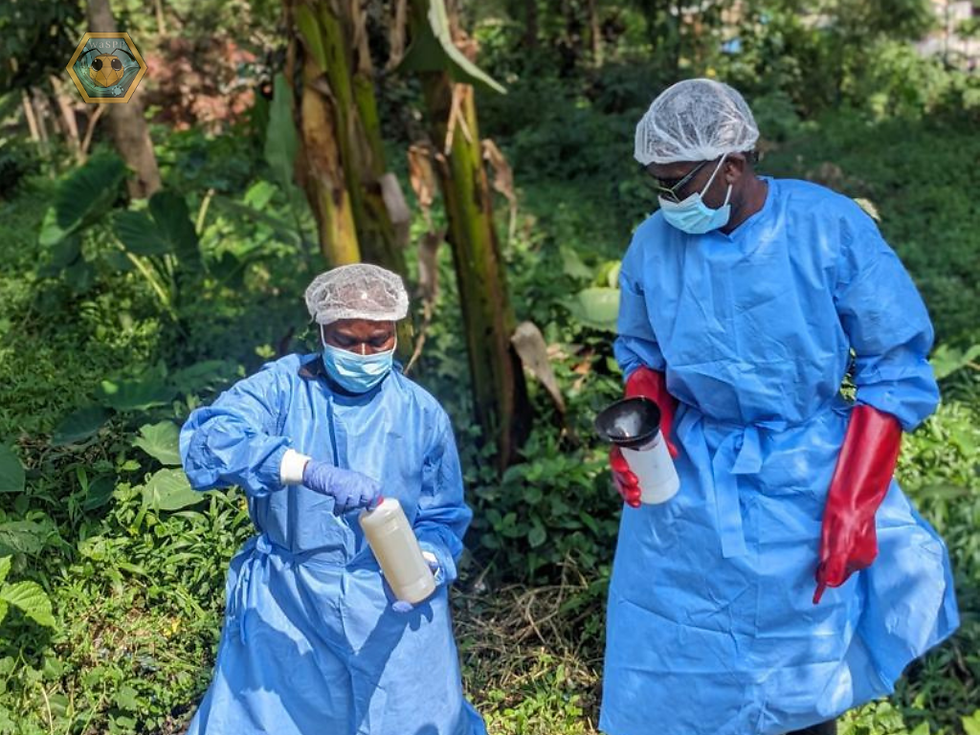
Equally important was ensuring institutional readiness by providing training before sample collection. A two-day training was held in each province to provide insight regarding the study's aim and detailed methods. The first-day session was conducted in class, covering methods for preparing, executing, handling, and finally shipping the samples to the UGM lab. On the second day, participants visited each sampling point and simulated sampling methods. The training helped the WES operators across sites and provinces to work in accordance with the standardised protocol.

Why This Work Matters Now
We know that strong surveillance systems are essential in preventing catastrophic public health outcomes. Wastewater surveillance offers a promising early warning capability, but only if it is adapted to local environmental and epidemiological contexts.
By grounding site selection in real epidemiological risk, population coverage, and infrastructure feasibility, the team in Indonesia is taking a step towards the vision of a more comprehensive integrated surveillance system, moving from data collection to a reliable system that bridges environmental signals with public health action.
About the Authors:
Dr Vicka Oktaria, MPH, PhD, FRSPH—Principal Investigator of WaSPP in Indonesia
Rizka Dinari, MPH—Project Manager of WaSPP in Indonesia
Affiliation:
Department of Biostatistics, Epidemiology, and Population Health (BEPH), Faculty of Medicine, Public Health, and Nursing, Universitas Gadjah Mada, Yogyakarta, Indonesia
Center for Child Health (CCH-PRO), Faculty of Medicine, Public Health, and Nursing, Universitas Gadjah Mada, Yogyakarta, Indonesia


Comments